Treatment & service / Design study / COARSE-SCREEN-R1
See the service sequence.
A perforated cartridge, capture mechanism and contained-removal geometry.
Retained development study. Dimensions, names and checks belong to this revision—not automatically to the retrofit-only product. Manufactured tank shells are deferred. No installation instruction, certification or manufacturing release is represented.
The source reasoning
Why this detail was investigated.
The study considers how a wet cartridge can be captured before withdrawal. It does not establish hydraulic isolation or a safe field procedure.
Read the research and limits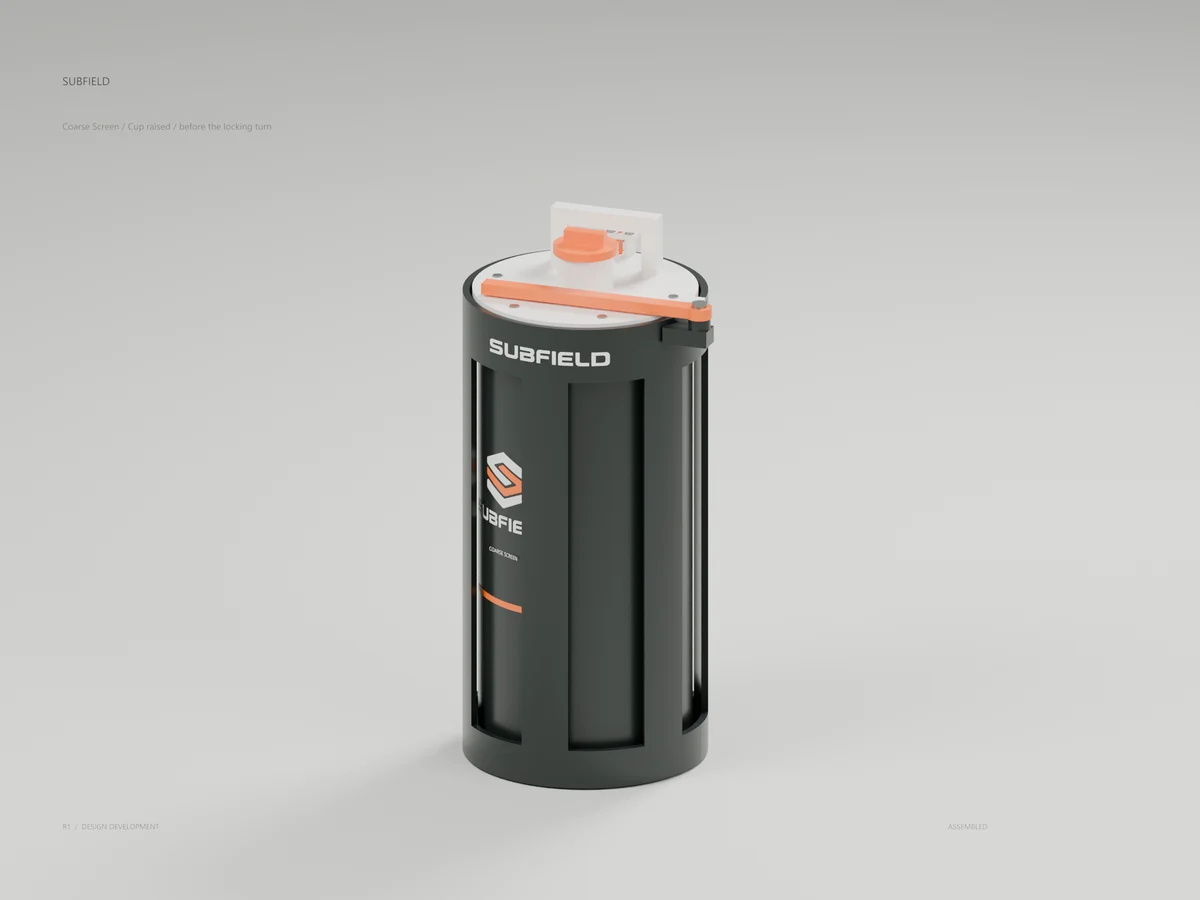
Research record
The detail behind
the study.
Source-linked work for this revision. Reported checks describe the stated model or test; physical qualification and applicability to the current retrofit remain separate.
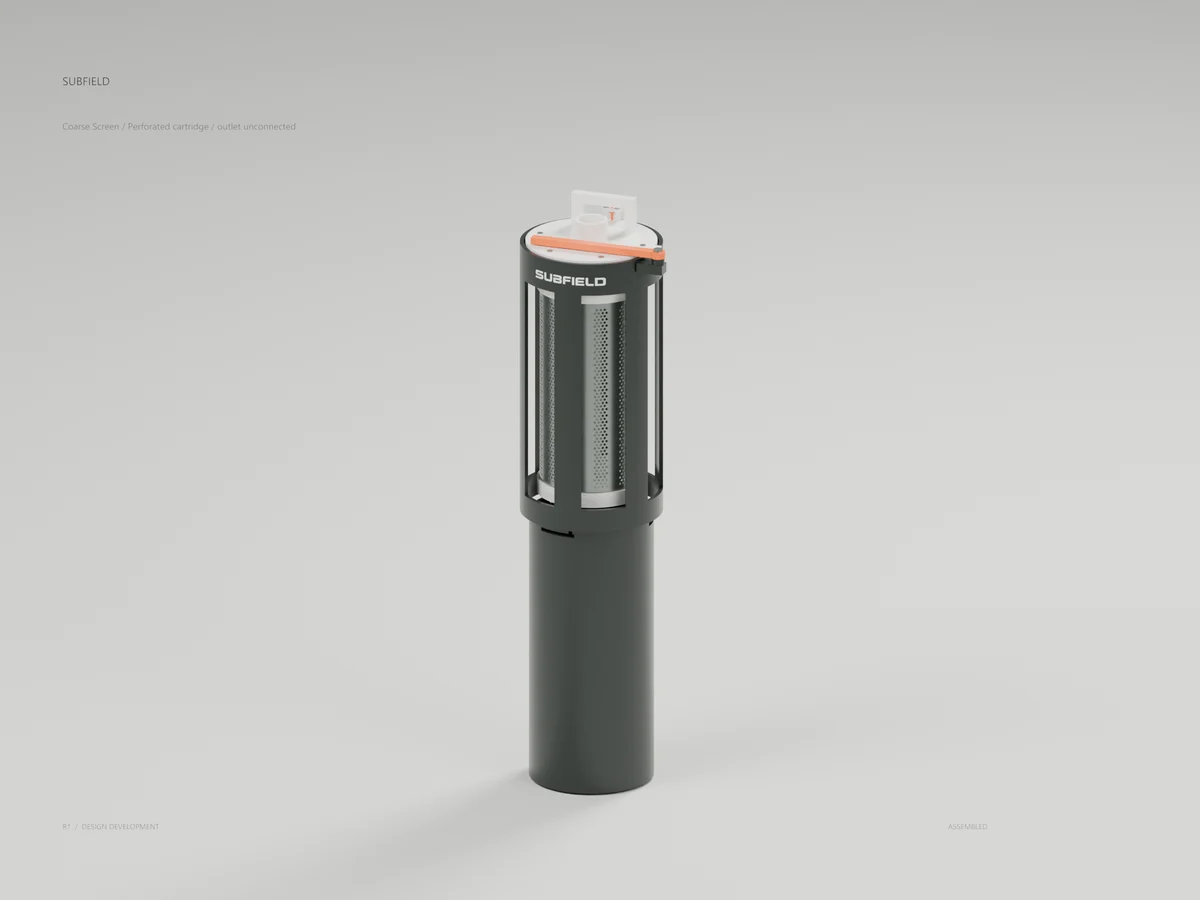
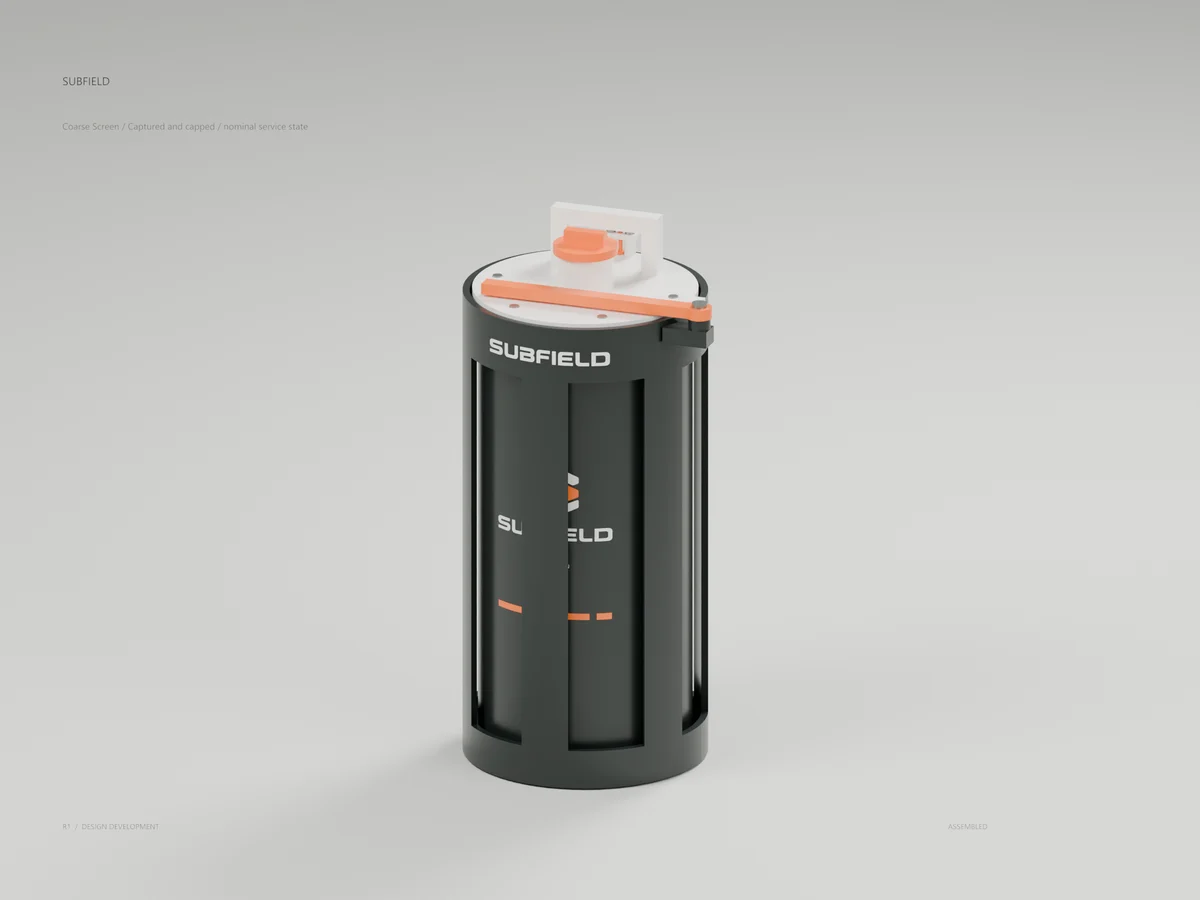
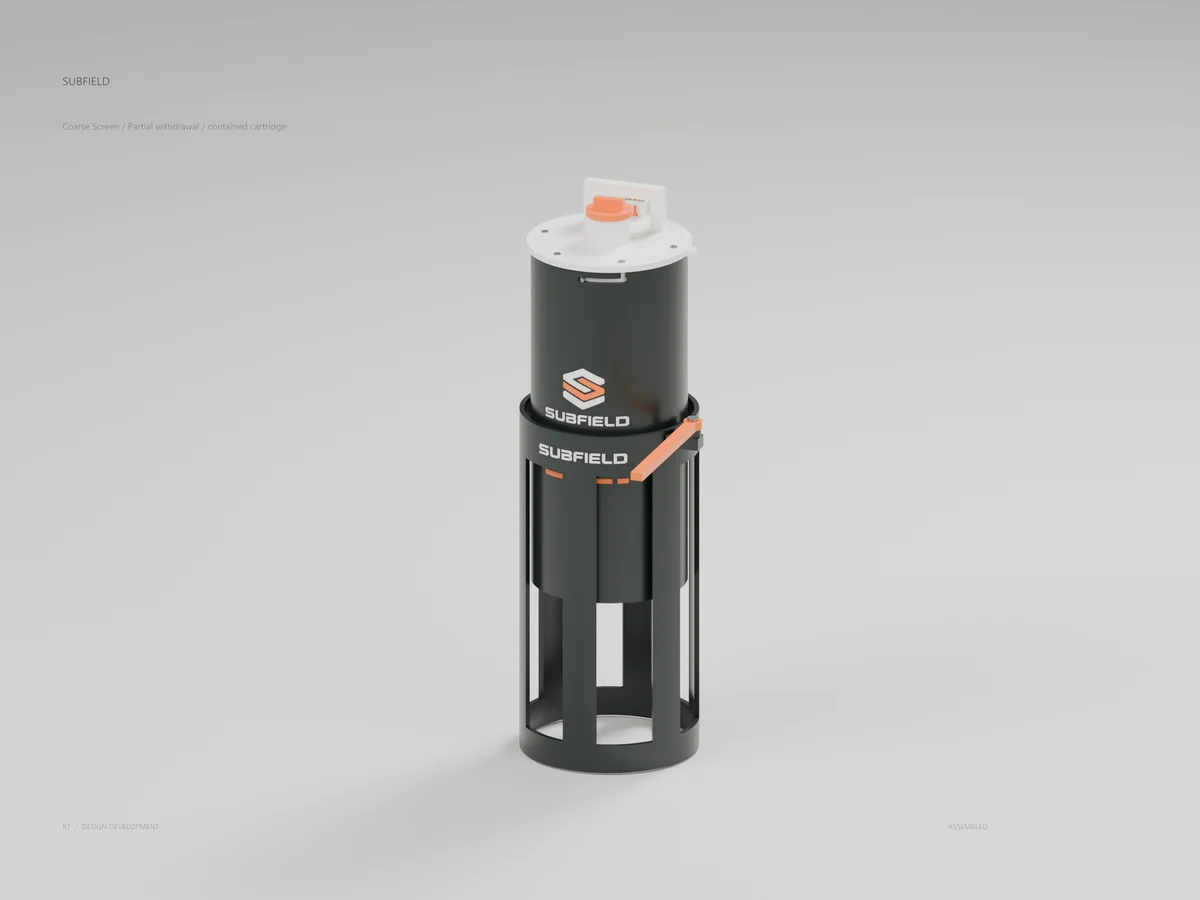
Eight CAD-driven views of the perforated insert and capture mechanism. Development concept; flow connection, grade operation and manufacturing qualification remain open.
Review PDF · Assembly STEP · 3D model
Seated / outlet unconnected
Cup raised / unlocked
Captured / locked and capped
Partly withdrawn
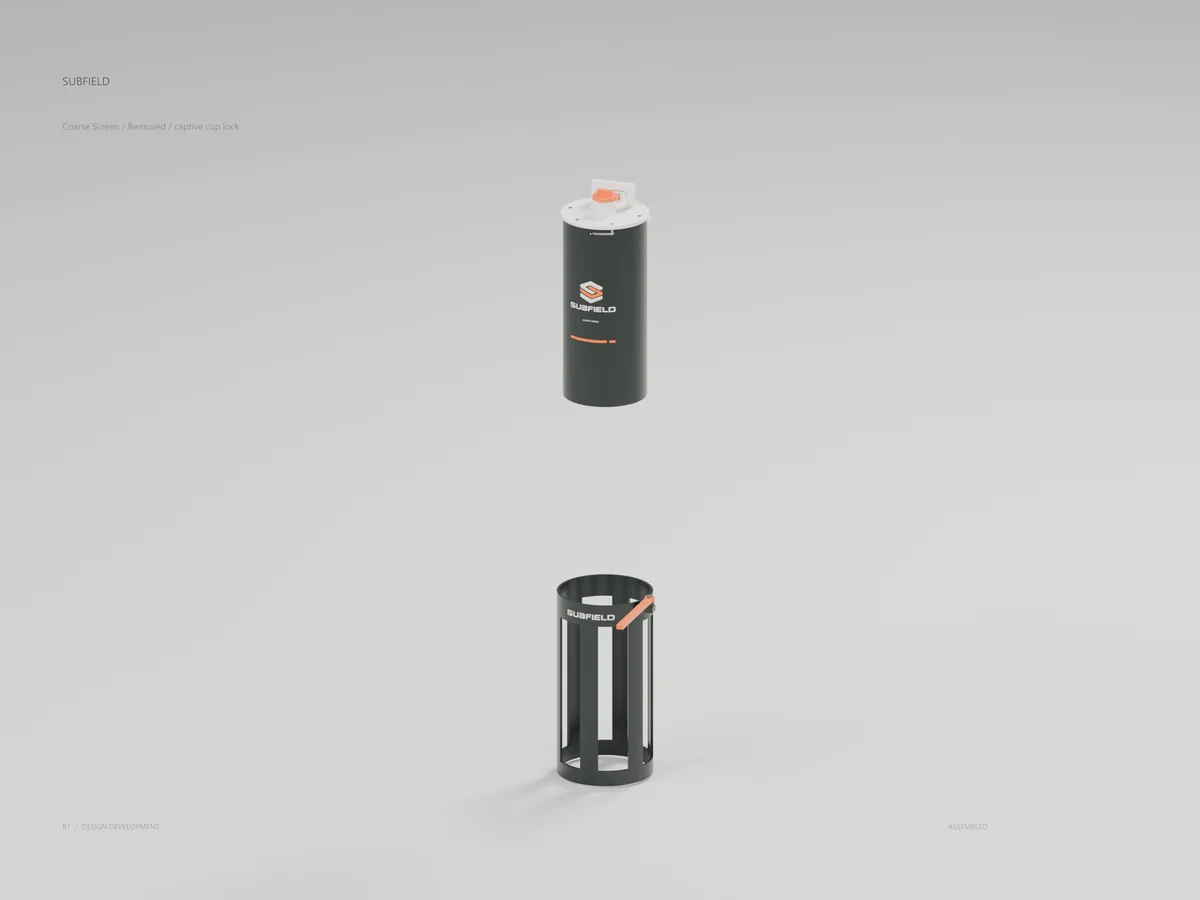
Removed / contained geometry
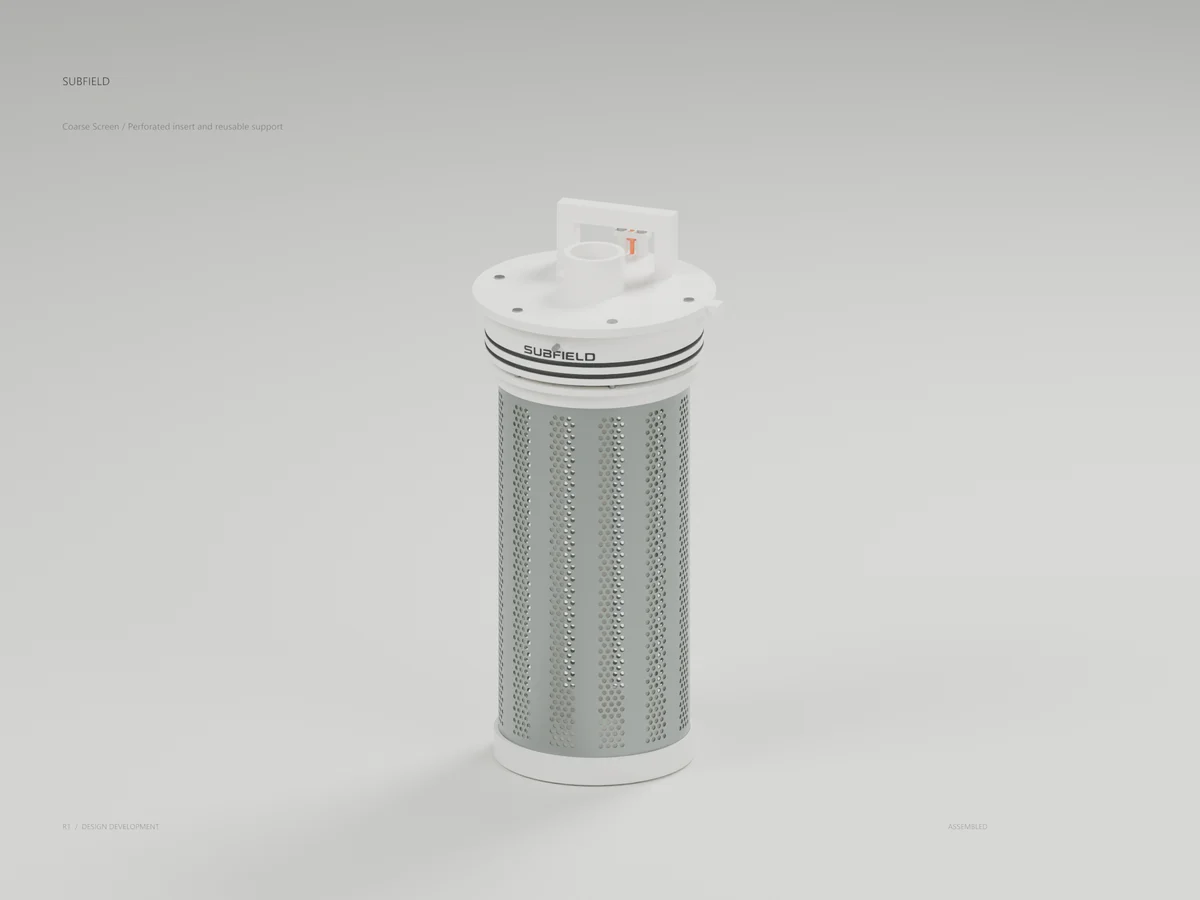
Perforated cartridge
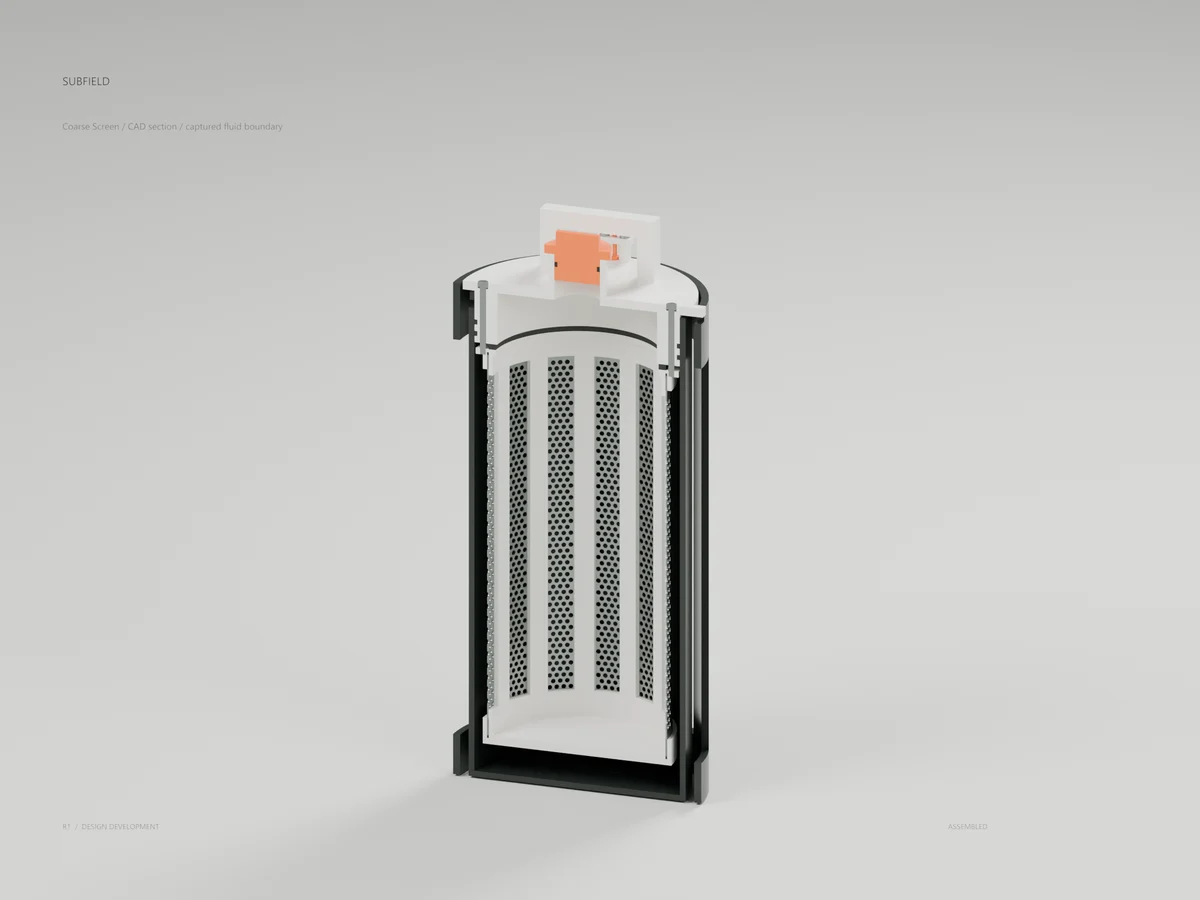
Section / nominal fluid boundary
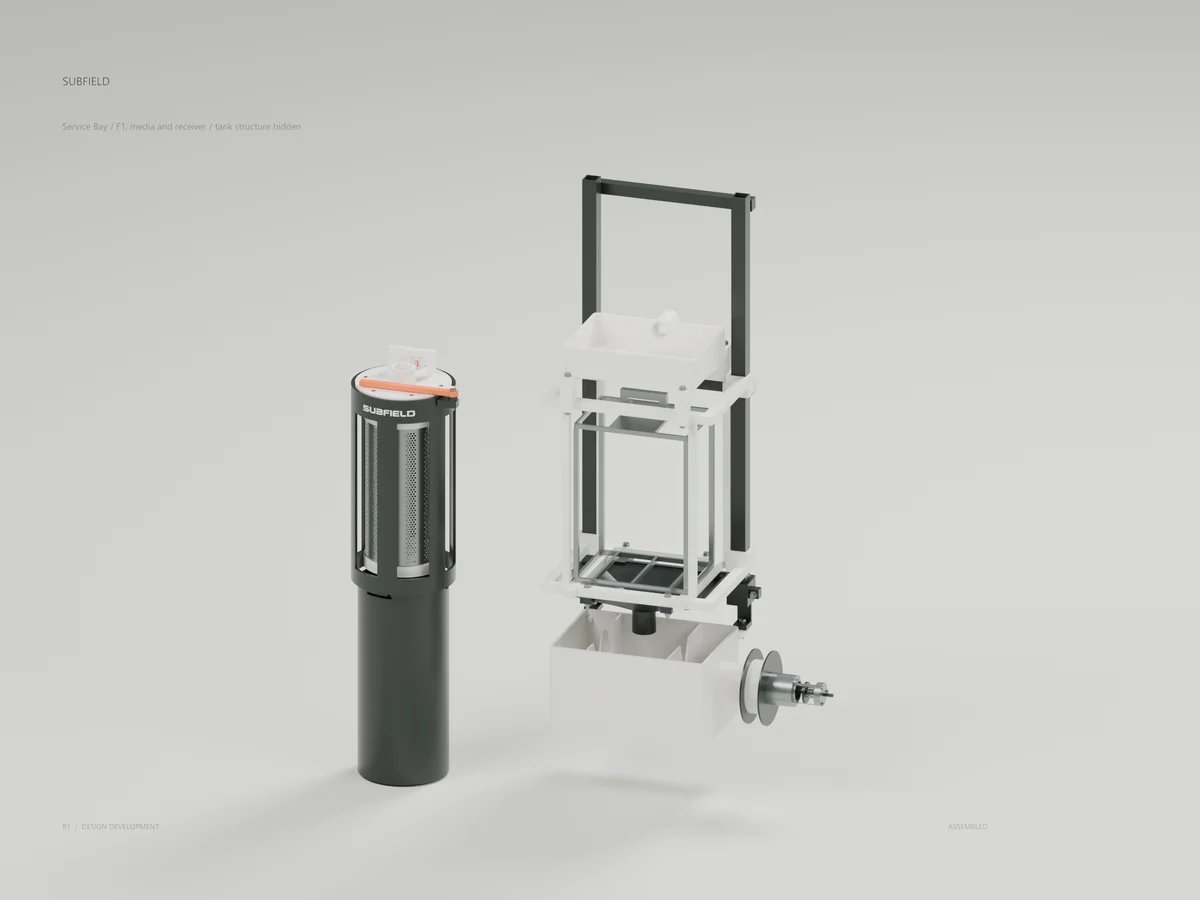
Service-bay detail / tank structure hidden
CONCEPT development package. Original Subfield branding is applied to actual CAD meshes. The outlet remains unconnected, and hydraulic duty, grade handling, containment and manufacturing qualification remain unresolved.
CAD uses mm, Z up. Screen-local origin is tank [435,-550,1150]. GLB and Blender use metres. The 3.175 mm hole diameter, .9525 mm wall and staggered pitch are test candidates referencing a commercially available flat-sheet pattern. The actual model has 2,352 custom radial holes in twelve zones; it is not a supplier rolled product or a released flat pattern. Seam, joining, deburring, chemical behavior and useful solids/flow performance remain unqualified.
The cartridge has a closed base, separate end potting, a flat head-gasket study and an unconnected 32 mm top bore. The external cup raises 340 mm, turns 30 degrees around three pins, then receives a captive anti-rotation plunger. Two compressed radial rings lie below the bayonet slots. The orange top cap is a separate service item with no qualified retention/tether; it does not establish process isolation.
The CAD states assume a separately established isolation condition and deliberate capping before withdrawal. No safe physical procedure is released. Cup actuation/rotation from grade, long guides, support mounting, controlled drainage, finite storage/fault response and retained cap handling remain to be developed. The head and bridge screws are nominal M4 envelopes with no thread helices. The six head screws sit on a 132 mm bolt circle with separate 0.8 mm compressed bolt-seal washers; physical wet-boundary sealing remains unqualified. See verification/service-boundary-review.json. The liquid estimate counts the main modeled cup/core cavity and excludes small gland/bolt-clearance voids. No latch, pin, handle, seal, material, potting or fastener load is qualified.
The tank fit checks only the 500 mm cover case. The actual screen opening and 30 mm external handling allowance clear the other modeled lanes; these checks do not qualify reach, lifting or deep-cover operation. The potting, retainer and later bolt/capture-ring collisions were corrected and retained as evidence; the new regression test checks every full assembly state.
The expensive insert is cached only under ignored generated/coarse-screen-cache. The cache key includes element parameters, generating function source, geometry helpers and the pinned lockfile; its file hash is checked before use. Actual CAD tessellation is cached separately for the whole insert and its section, with generating-source and mesh hashes. Unchanged earlier insert meshes were reused with provenance in verification/insert-mesh-cache-provenance.json. Clearing either cache recomputes it from source.
Render with Blender 5.2.1, --python-exit-code 1 --python coarse_render.py, the scene folder and this package's brand/. Use coarse_fit_render.py for the tank-fit service-bay detail. Each folder uses render state assembled; its particular mechanical state is already in the meshes. Review/render/package helpers expect the original septic/cad, outputs and work layout.
Complete the actual protected flow path, material/process and tolerance specification, tooling, inspection and physical qualification before manufacturing release. A concept STEP and render do not supply those approvals.
Source and revision record
Source: coarse-screen-r1/index.html
Source SHA-256: d5e264eb41585eb1eec3f07d4b9fec81ac7b7697a9526d046627e13c6e8033e4
Geometry and images describe this development revision. Current product ratings and manufacturing release require separate qualification.
Keep exploring the research.
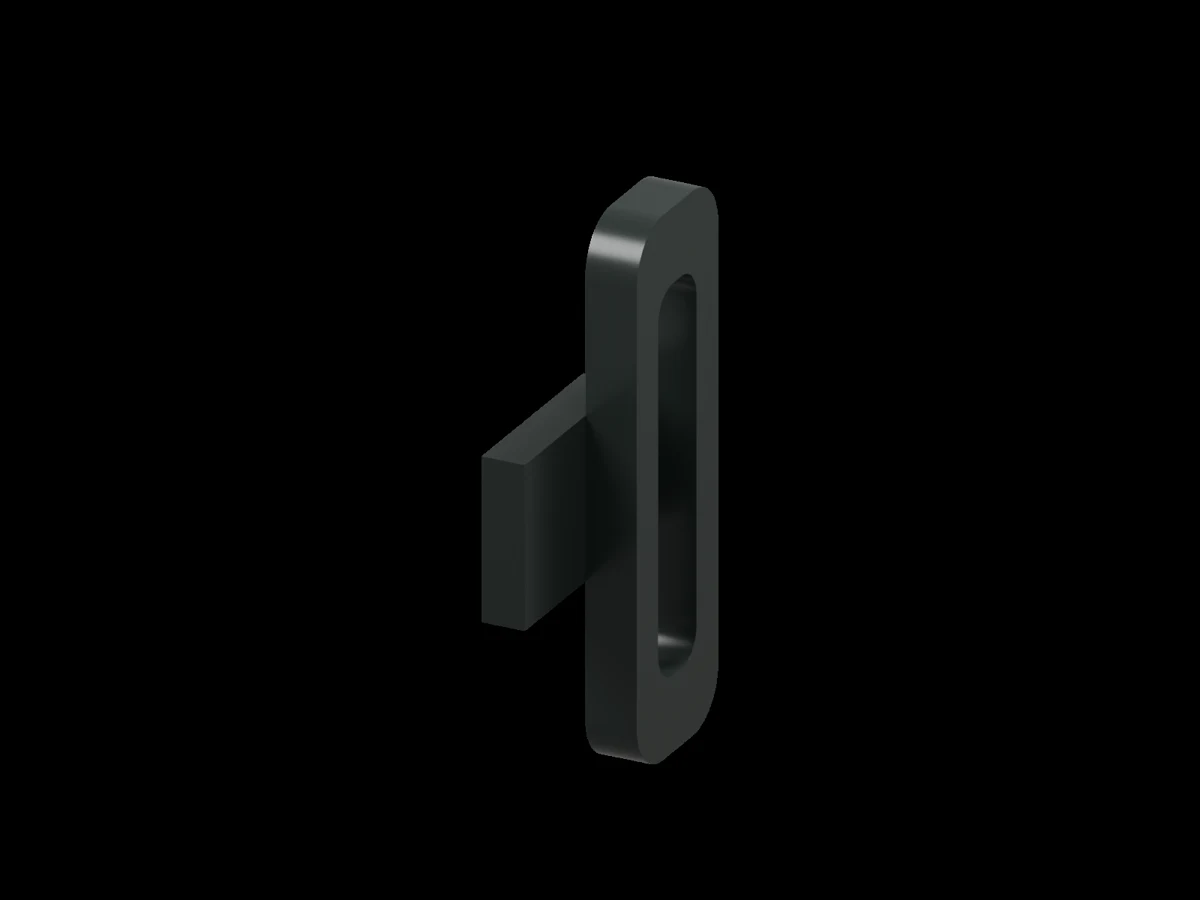
Treatment & service / Development study
Subfield UV · Service review R2
Inspect the separate two-solid handle correction candidate and the engineering limits behind it.
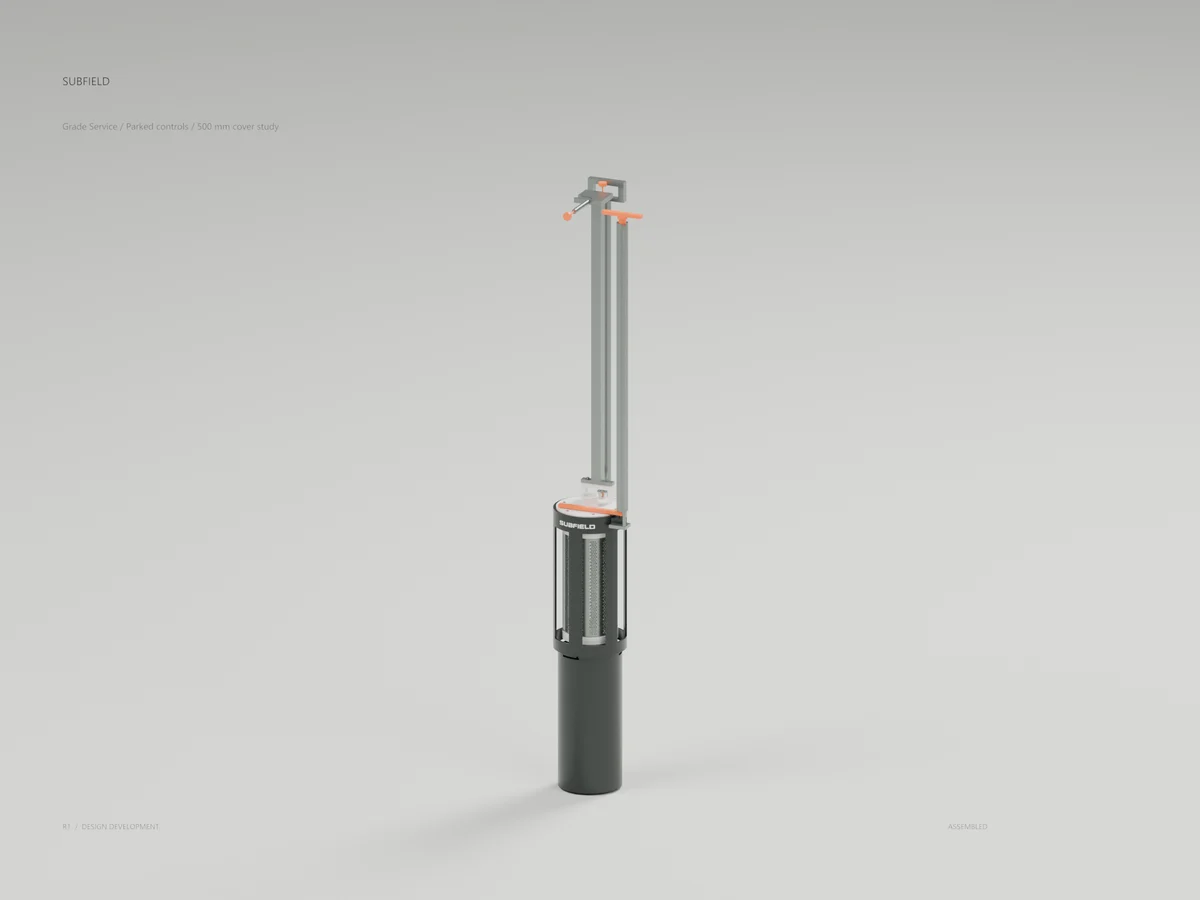
Treatment & service / Design study
Screen grade controls
Long controls, capture hardware and the screen extraction arrangement.
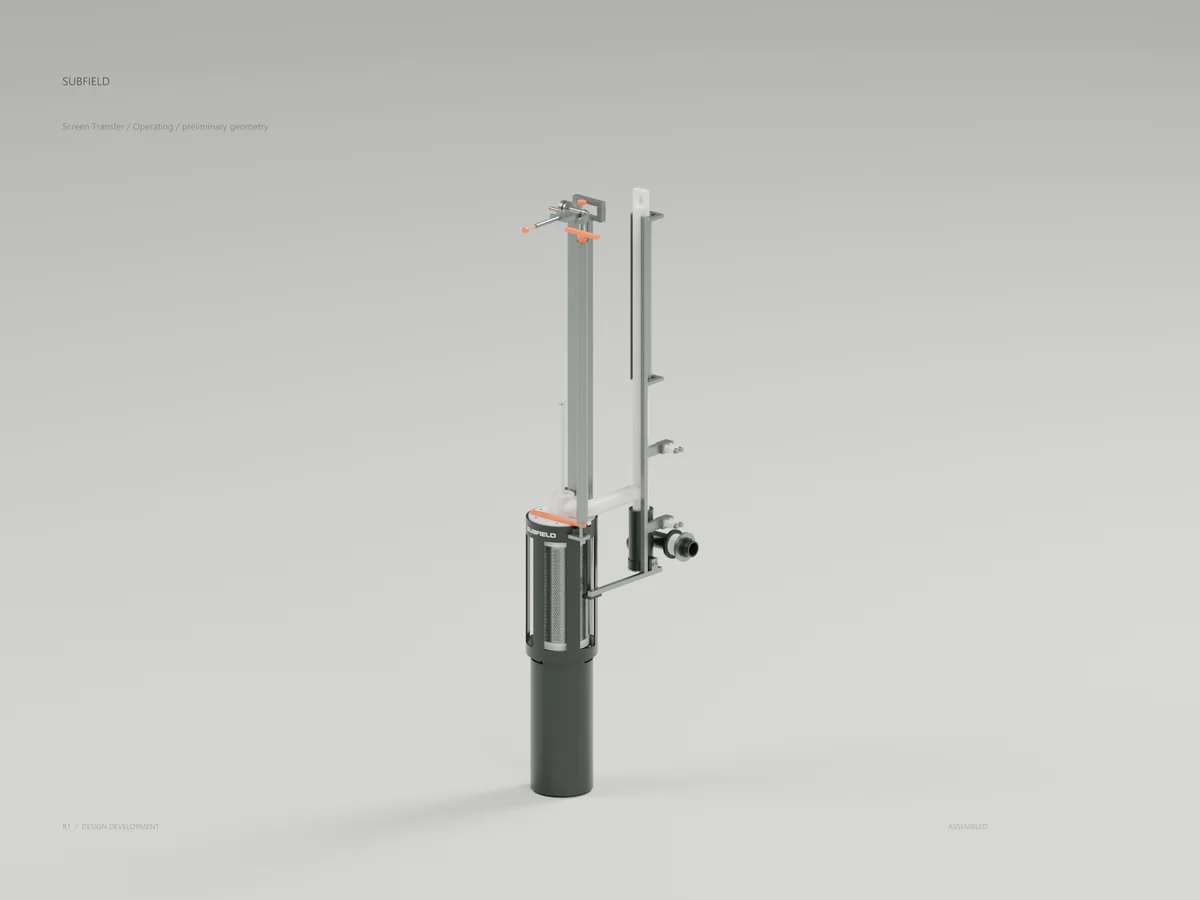
Treatment & service / Design study
Screen transfer
A removable bridge and vented transfer arrangement around the coarse screen.
Return to the current product.
Explore the retrofit-only platform and its compatibility, installation and service objectives.
Explore the retrofit