Controls / Current architecture / mechanical interface / CONTROLLER-PLATFORM-V1
One platform. Three electronic roles.
Study overview
Control A2: industrial supervision, deterministic tank control and reusable PoE sensing for the retrofit. Purpose-linked component IDs connect the mechanical study to the build plan.
Retained development study. Dimensions, names and checks belong to this revision—not automatically to the current retrofit system. Manufactured tanks are not offered. No installation instruction, certification or manufacturing release is represented.
The source reasoning
Why this detail was investigated.
The source reasoning
Keep treatment local, isolate application software from process permissions, and make every serviceable part understandable. Researched components and named space allocations are development evidence, not a routed or physically qualified board.
Control, Hub and PoE sensor architecture
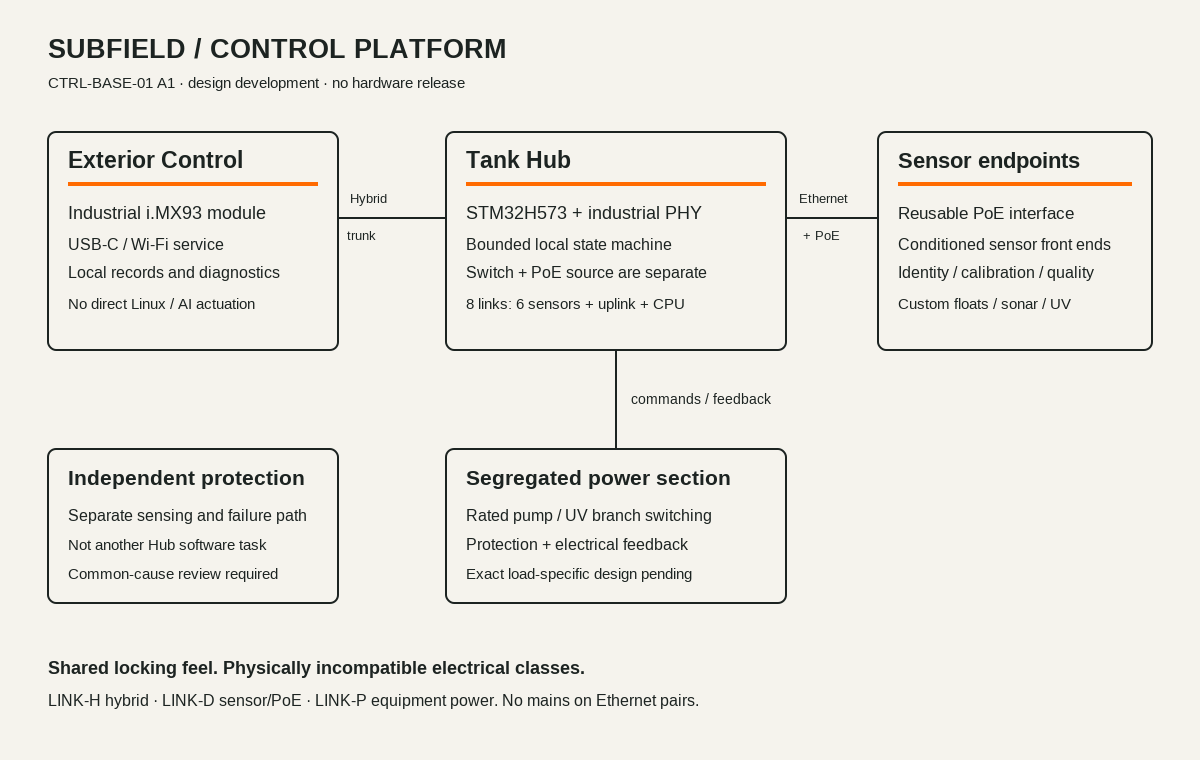 Open the full-size review drawing
Research record
The detail behind
the study.
Source-linked work for this revision. Reported checks describe the stated model or test; physical qualification and applicability to the current retrofit remain separate.
Read the research and limits
Control A2: one retrofit platform
The core product upgrades qualified existing tanks; manufactured tank shells are not active product dependencies. Exterior Control supervises. Accepted Option A keeps actual pump and UV switching in a separately protected, stationary tank-side power compartment. No universal fit, approved service interval or treatment rating is implied.
| Role / model IDs | Research lead | Purpose |
|---|---|---|
| Exterior Control / C01–C05 | PHYTEC PCL-077 / NXP i.MX93 reference | Local interface, records, authorized USB-C/Wi-Fi service and secure updates; no direct Linux or AI actuation. |
| Hub logic / H01–H07 | STM32H573VI family + DP83826AE PHY | Deterministic process permissions, measurements and feedback. Independent protection is a separate assembly. |
| Sensor endpoint / S01–S04 | PoE receiving controller and reusable acquisition design | Sensor identity, units, freshness, calibration and appropriate conditioned inputs; exact endpoint parts remain open. |
Modern features that serve a purpose
The development requirements include signed updates with trial boot and recovery, unique device credentials, scoped professional access, local incident recording, power/network diagnostics, traceable installed parts and offline service. Essential operation does not depend on a hosted subscription. Hardware execution and production firmware remain unqualified.
Media health, not an invented cleanliness score
The observation contract distinguishes possible restriction, aeration faults, process review, sensor service and unknown conditions. Flow and operating context, timestamps, validity and baselines belong with each diagnosis. Normal biological growth is not a replacement trigger. Witness strips remain experimental; equipment state cannot certify effluent quality.
Six sensors still require eight network connections
Six sensor ports, the trunk uplink and the Hub CPU require eight usable network connections. A TPS23881 PoE power controller is not a network switch. The switch/PSE, actual motor/UV power assembly and independent protection are outside the three low-voltage board models. Complete electrical and thermal selection remains open.
Purpose-linked 3D models
A2 defines three preliminary board outlines and fixed removable carriers plus sixteen named component-space objects. Four use documented XY envelopes with explicitly reserved heights; twelve are functional space reservations, not selected package geometry. No invented traces, pins or populated-PCB claim. Exact supplier models and routed ECAD must replace allocations before manufacture.
The executable generators produce per-role and combined STEP, GLB, dry-fit carrier STL, a component manifest and digital verification records. Source: tools/control_platform/generate_mechanics.py and generate_layout.py. Inputs: contracts/hardware/control-platform.v1.json and control-layout.v1.json. Units are millimetres in STEP/STL and metres in GLB.
An organized build, not every development kit at once
The staged build plan starts with the STM32H573I-DK and simulated low-voltage inputs, then the industrial supervisor, then a correctly powered network/sensor fixture. Parts have stable IDs and a stated job. Ordinary Amazon-friendly bench supplies are separated from exact industrial kits and unresolved production parts. No live pump, UV or mains wiring belongs on the breadboard.
Required before hardware release
Exact order codes, pin allocation, schematic/netlist, footprints, PCB layout, power/signal integrity, isolation, thermal/EMC, independent protection, model-to-ECAD correspondence and physical fault testing remain open. Digital geometry and software checks are not electrical or treatment qualification. Subfield develops its own assemblies and purchases OEM pumps; the blower manufacturing exception is still an owner decision.
Source and revision record
Source: contracts/hardware/control-platform.v1.json
Source SHA-256: 024cbcd170c5dd4499894024b9065dbca680a1502847dcc713745f66ff0cffd5
Geometry and images describe this development revision. Current product ratings and manufacturing release require separate qualification.
Industrial supervisor development kit
Eight-port network evaluation reference
Configurable acquisition front end
Keep exploring the research.
Return to the current product.
Explore the retrofit system and its compatibility, installation and service objectives.
Explore the retrofit